Best Under-Sink Filters 2026: Expert Picks
Under-sink filters deliver the highest flow rates, deepest filtration, and most convenient daily experience of any home water filtration category. We tested 4 systems ranging from a $199 6-stage RO to a $505 commercial-grade Pentair to find the best options for every budget and water quality challenge.
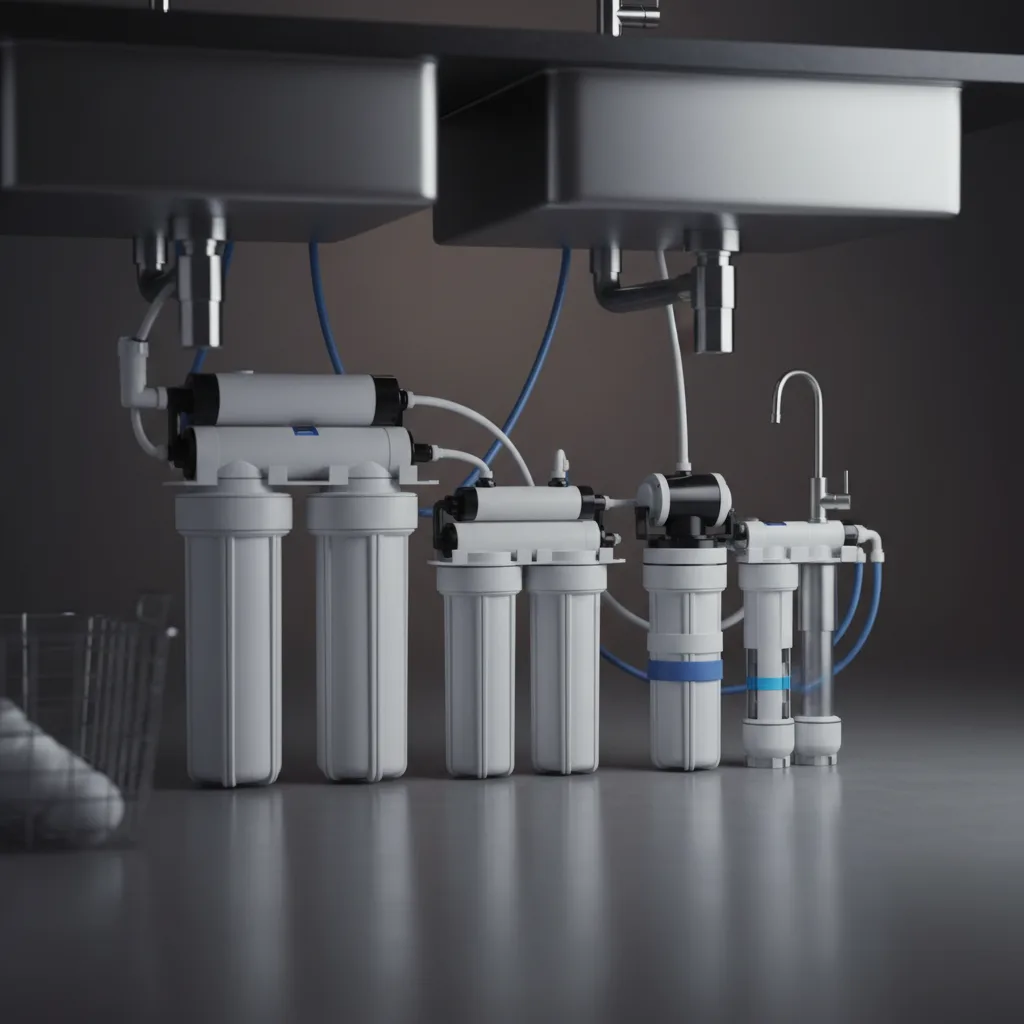
Quick Picks: Our Top Recommendations
| Feature | Editor's Pick Pentair Everpure H-1200 Replacement Cartridge Set | Pentair Everpure H-300 Drinking Water System | iSpring RCC7AK 6-Stage Reverse Osmosis System | Waterdrop G3P600 Tankless Reverse Osmosis System |
|---|---|---|---|---|
| Price Range | $250–$500 | $500+ | $100–$250 | $250–$500 |
| Stages | 2 (twin cartridge) | 1 | 6 | 8 |
| Technology | Micro-Pure activated carbon + precoat submicron | Micro-Pure activated carbon + precoat submicron | Sediment + GAC + CTO + RO Membrane + Alkaline Remineralization | PP + CTO + RO Membrane + Post Carbon (tankless) |
| Capacity | 1,000 gallons | 300 gallons | 75 GPD | 600 GPD |
| Flow Rate | 0.5 GPM | 0.5 GPM | 75 GPD | 600 GPD |
| Micron Rating | 0.5 | 0.5 | 0.0001 | 0.0001 |
| Filter Life | 12 months or 1,000 gallons | 6-12 months or 300 gallons | 6-12 months (pre/post filters), 2-3 years (RO membrane) | 6 months (CF filter), 12 months (MRO filter), 24 months (CB filter) |
| Check Price | Check Price | Check Price | Check Price |
The biggest decision in under-sink RO is tank vs. tankless. Tank systems (iSpring) cost less but take up cabinet space and produce water at 75 GPD. Tankless systems (Waterdrop) are compact and produce 600 GPD but cost more and need an electrical outlet. Choose based on your cabinet space and budget.
1. Pentair Everpure H-1200 Replacement Cartridge Set — Best Commercial-Grade Home Filter
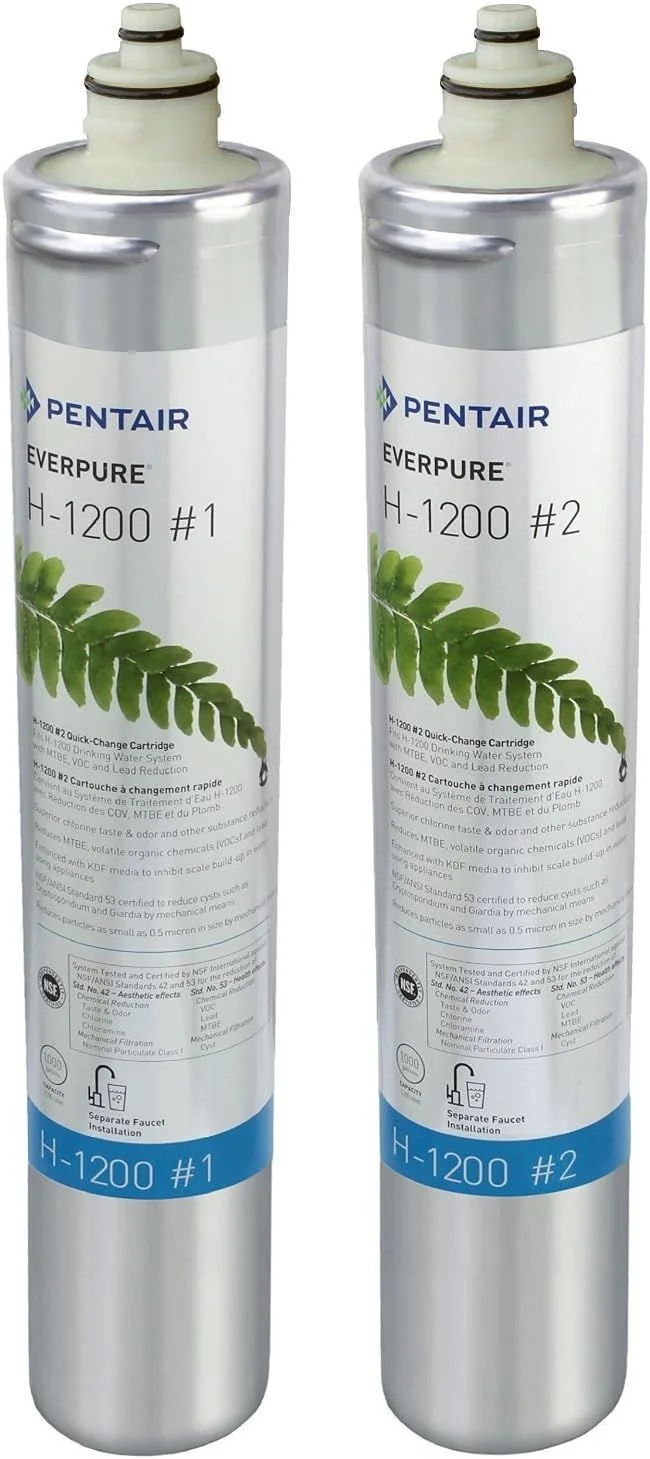
The Pentair Everpure H-1200 cartridge set represents the pinnacle of non-RO under-sink filtration. These are the same cartridges used in Starbucks, McDonald's, and thousands of commercial kitchens worldwide. The twin-cartridge design provides 1,000 gallons of capacity at 0.5-micron filtration, catching lead, cysts, PFOA, PFOS, and chlorine with NSF 42/53/401 certification.
At $390 for replacement cartridges alone (the filter head is sold separately), this is the most expensive option in our lineup by a wide margin. But the 1,000-gallon capacity means most households only replace cartridges once per year. The water quality improvement is immediately noticeable — coffee and tea taste better, and the water has a clarity that pitcher filters cannot match.
This is not an RO system, so it does not remove TDS or fluoride. What it excels at is removing health-critical contaminants (lead, cysts, PFAS) while preserving natural minerals and maintaining excellent flow rates. For households with municipal water that is already low in TDS but may contain lead or PFAS, the H-1200 is the professional-grade solution.
- Commercial restaurant quality — same brand used in Starbucks and McDonald's
- 1,000-gallon capacity means fewer replacements per year
- 0.5-micron filtration catches cysts, lead, PFOA, and PFOS
- Very expensive at $390 for replacement cartridges alone
- Requires existing H-1200 filter head (sold separately)
2. Pentair Everpure H-300 Drinking Water System — Best Complete Under-Sink System

The H-300 is Pentair Everpure's complete system package, including the filter head, cartridge, dedicated faucet, and all installation hardware. This eliminates the guesswork of buying components separately. You get the same commercial-grade 0.5-micron filtration that restaurants trust, in a ready-to-install kit.
The trade-off versus the H-1200 is capacity: 300 gallons versus 1,000. For a household of 2-3 people, that means cartridge replacements every 4-6 months rather than annually. At $505 for the complete system, the upfront cost is steep, but you are buying a filter head that will last decades with only cartridge swaps needed going forward.
The single-cartridge design is more compact than the twin H-1200, making it easier to fit in tight under-sink cabinets. Quarter-turn cartridge replacement is genuinely tool-free and takes under 30 seconds. If you want the Pentair commercial pedigree without buying the head and cartridges separately, the H-300 is the all-in-one answer.
- Complete system — includes filter head, cartridge, faucet, and all hardware
- Commercial-grade 0.5-micron filtration used in restaurants worldwide
- Simple quarter-turn cartridge replacement — no tools needed
- Most expensive single system at $505 — premium investment
- Only 300-gallon capacity vs 1,000 for the H-1200
3. iSpring RCC7AK 6-Stage Reverse Osmosis System — Best Value Under-Sink RO
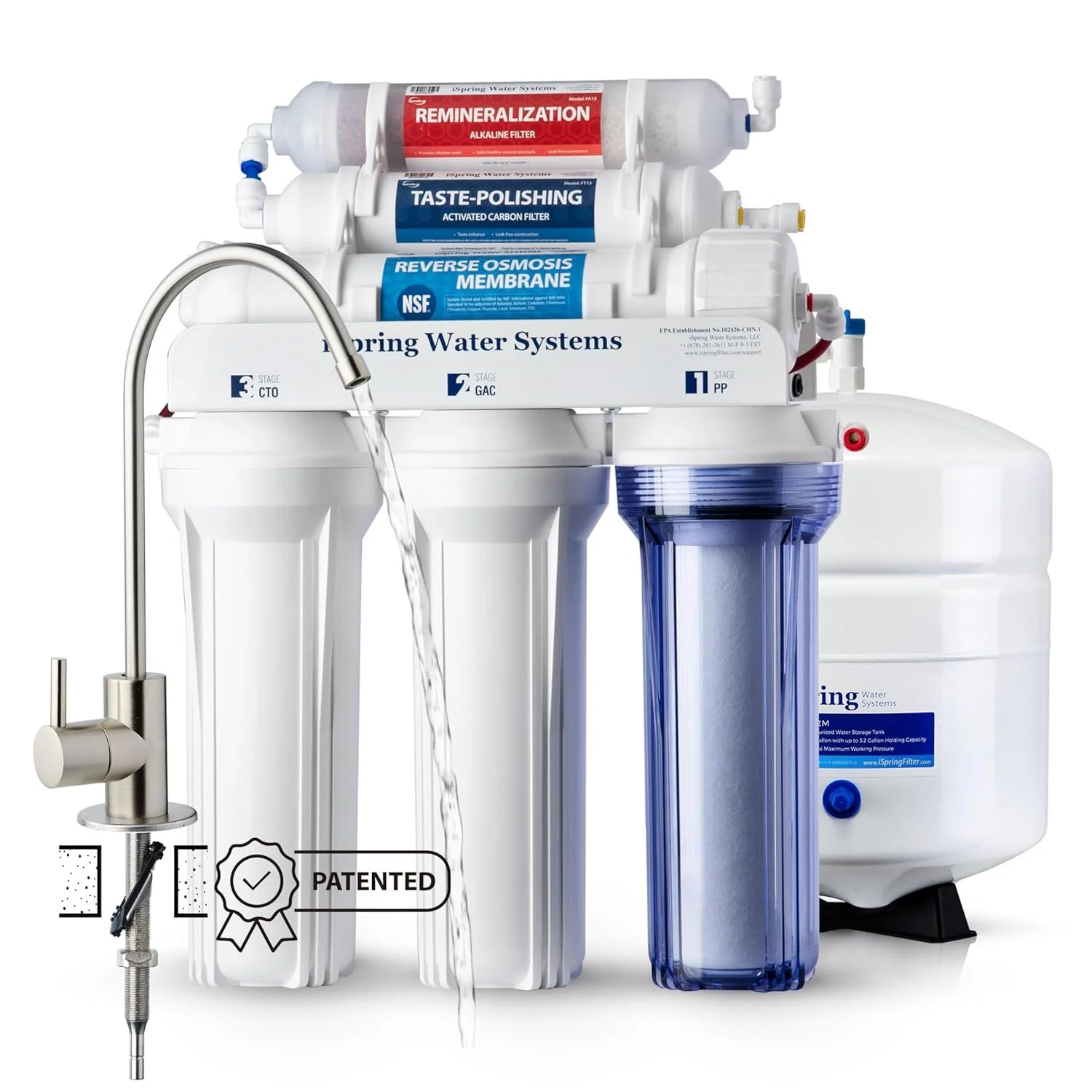
The iSpring RCC7AK is the best-selling under-sink RO system on Amazon for good reason: six filtration stages including alkaline remineralization, NSF 58 certification, and a sub-$200 price point that undercuts comparable systems by $100 or more. With 18,000+ reviews and a 4.6-star rating, long-term reliability is well-documented.
The 6-stage process starts with sediment and carbon pre-filters, passes water through a 0.0001-micron RO membrane that removes 93-98% of TDS, and finishes with post-carbon polishing and an alkaline remineralization stage that restores healthy minerals and improves pH. The result is water that is both pure and pleasant-tasting.
At 75 GPD, this is not a high-volume system — the pressurized tank stores about 3 gallons of filtered water for on-demand use, which is sufficient for most households. The tank does take up meaningful cabinet space, and the 1:3 pure-to-drain ratio wastes more water than modern tankless systems. But at under $200, the iSpring RCC7AK remains the best value in under-sink reverse osmosis.
- Incredible value — full 6-stage RO with alkaline remineralization under $200
- NSF 58 certified with 93-98% TDS reduction
- Alkaline remineralization stage restores healthy minerals and improves pH
- Requires under-sink installation with drilling for the faucet
- Tank takes up significant cabinet space
4. Waterdrop G3P600 Tankless Reverse Osmosis System — Best Premium Under-Sink RO
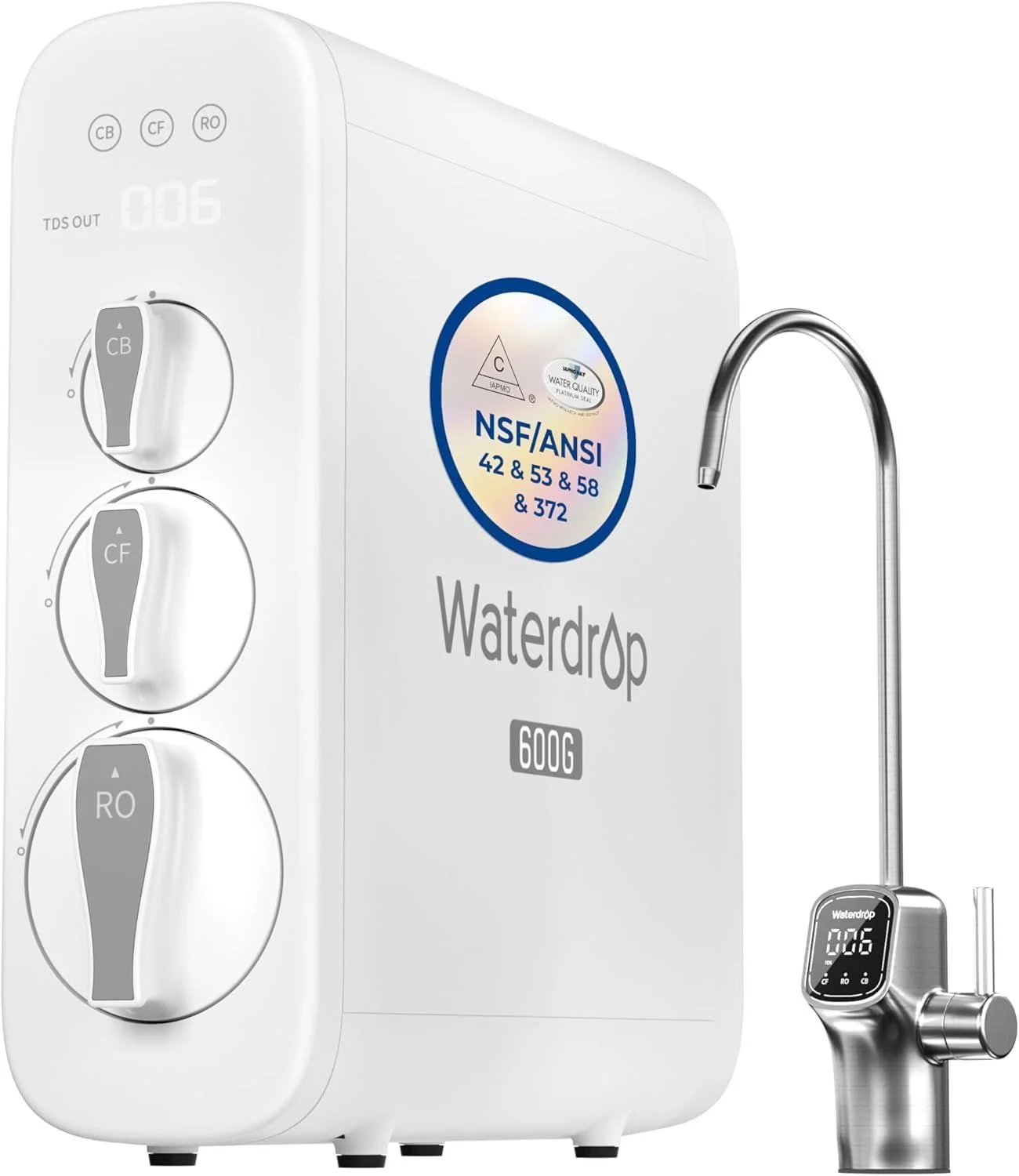
The Waterdrop G3P600 is the most technologically advanced under-sink filter in our lineup. Its tankless design produces 600 gallons per day — eight times faster than the iSpring — while taking up far less cabinet space. The smart LED faucet displays real-time TDS readings so you can verify your water quality with every glass.
The 2:1 pure-to-drain ratio is best-in-class for a residential RO system, wasting half as much water as traditional tank systems. The 8-stage filtration process delivers comprehensive contaminant removal with NSF 42/53/58/372 certification — the most certifications of any system in our roundup.
The premium comes at $429 and the requirement for an under-sink electrical outlet. The pump produces slight operational noise that is absent from passive tank systems. Proprietary replacement filters also cost more than the iSpring's widely-available cartridges. For buyers who prioritize speed, space savings, and water efficiency over upfront cost, the G3P600 is the future of home RO filtration.
- Tankless design saves massive under-sink cabinet space
- 600 GPD — 8x faster than traditional 75 GPD tank systems
- Smart LED faucet displays real-time TDS readings
- Premium price at $429 — more than double the iSpring RCC7AK
- Requires electrical outlet under the sink for the pump
How We Chose Our Picks
Under-sink filters are a long-term investment, so our evaluation prioritized factors that matter over years of daily use. We weighted filtration performance (what contaminants are actually removed, verified by third-party certifications), daily convenience (flow rate, faucet quality, noise level), total cost of ownership (upfront cost plus 3 years of replacement filters), and installation requirements (DIY-friendliness, space needed, tools required).
We cross-referenced manufacturer claims against NSF certification databases and Amazon reviewer feedback to identify any discrepancies between marketing and real-world performance. Products with higher NSF certification levels received ranking boosts because independent verification matters more than lab-condition marketing claims.
Buying Guide: What to Look For in an Under-Sink Filter
Under-sink filtration is the most effective point-of-use water treatment for homes. Here are the key factors to evaluate before purchasing.
Reverse osmosis vs. carbon filtration: RO systems (iSpring, Waterdrop) remove 93-99% of all dissolved solids, including fluoride, PFAS, and heavy metals. Carbon systems (Pentair Everpure) excel at removing chlorine, lead, cysts, and particulates while preserving natural minerals. Choose RO if your TDS is high or you have specific dissolved contaminants. Choose carbon if your water is already low-TDS but needs taste improvement and targeted contaminant removal.
GPD rating matters for flow: A 75 GPD system with a tank provides about 3 gallons of stored water. A 600 GPD tankless system delivers on-demand water at near-tap pressure. For households of 4+ that use filtered water for cooking, coffee, and drinking, a higher GPD rating prevents running out during peak usage.
Before buying an under-sink system, check two things: (1) Do you have enough cabinet space under the sink? Measure depth, width, and height. (2) For tankless systems, is there an electrical outlet within reach? If not, you will need an electrician before installation, which adds $100-200 to your project cost.
Frequently Asked Questions
Can I install an under-sink water filter myself, or do I need a plumber?
How much water does an under-sink RO system waste?
What is the difference between a tank and tankless RO system?
How often do under-sink filter cartridges need replacing?
Do under-sink RO systems remove beneficial minerals from water?
Is an under-sink filter better than a countertop filter?
Which under-sink filter is best for well water?
Our Recommendation
For the best value in under-sink reverse osmosis, the iSpring RCC7AK at $198.78 is nearly impossible to beat. It delivers 6-stage filtration with alkaline remineralization at half the price of comparable systems. If you want the fastest, most space-efficient RO system and can afford the premium, the Waterdrop G3P600 is the best tankless option. For non-RO commercial-grade filtration that preserves minerals, the Pentair Everpure H-1200 cartridge set is the professional's choice.
Check Top Pick on Amazon