GE RPWFE Refrigerator Water Filter Review 2026
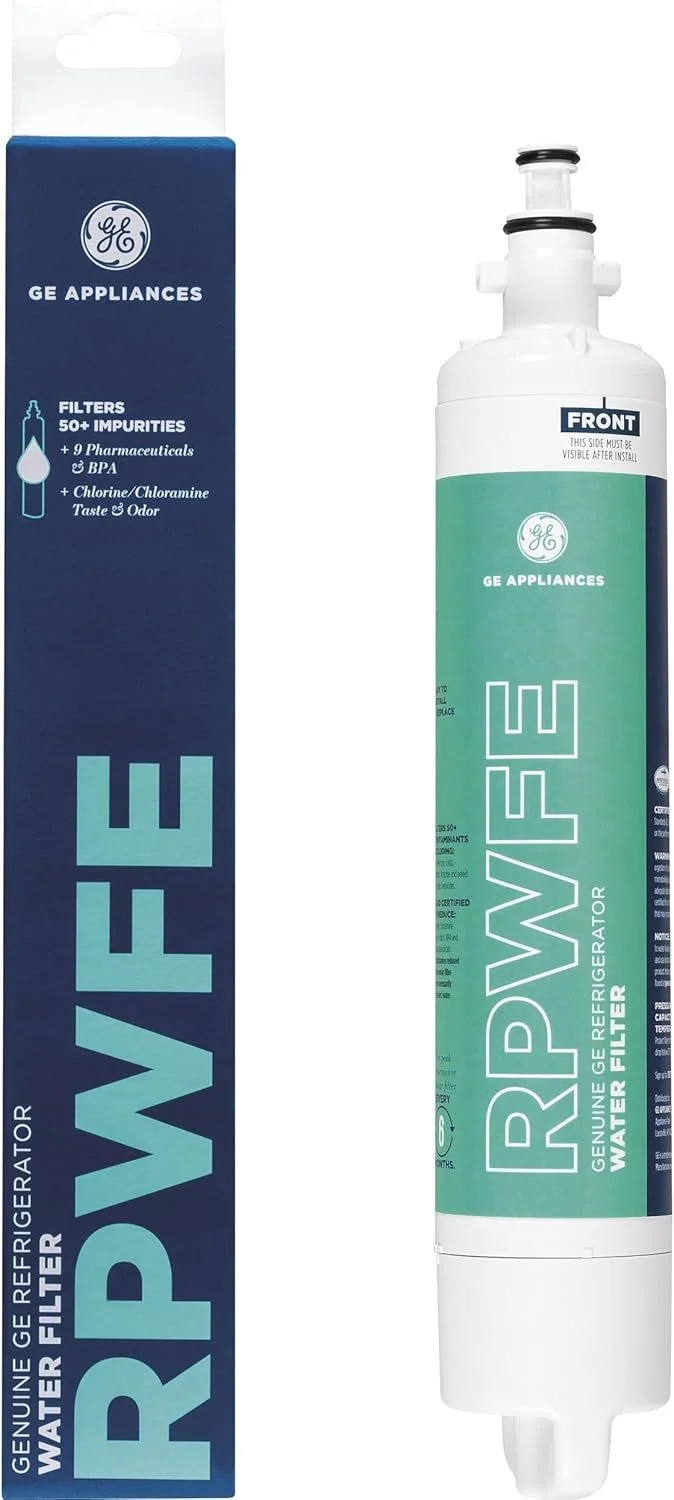
A solid OEM choice for GE French door owners, but the 170-gallon capacity is a drawback. If your fridge requires RPWFE, you don't have alternatives — but it does filter well.
Overview
The GE RPWFE is the designated OEM filter for GE French door refrigerators — a specific subset of GE's lineup that uses a rear-access filter housing rather than the interior-mounted design of XWFE models. At $49.95, it is priced nearly identically to the XWFE but delivers only 170 gallons of capacity compared to the XWFE's 300 gallons. That capacity gap is the RPWFE's biggest weakness, but if your GE French door fridge requires this specific filter, you do not have a realistic alternative.
Like the XWFE, the RPWFE includes an RFID chip that communicates with your refrigerator for authentication. The chip ensures filter recognition, automatic indicator resets, and in newer models, prevents water dispenser operation without a verified genuine filter. This effectively eliminates the aftermarket filter option for most RPWFE-compatible refrigerators, which is frustrating from a consumer choice perspective but does guarantee that every filter installed meets GE's quality and safety standards.
The filtration technology is GE's proven activated carbon block, certified under NSF 42/53 for chlorine taste reduction and lead removal. GE also claims reduction of PFOA, PFOS, and microplastics, though the RPWFE does not carry the NSF 401 certification for emerging contaminants that the XWFE holds. For practical purposes, the filtration quality is solid — the RPWFE delivers clean, great-tasting water and ice — but the 170-gallon capacity means more frequent replacements and a higher annual cost than its XWFE sibling.
Key Features & Specifications
| Technology | Activated Carbon Block |
| Capacity | 170 gallons |
| Certifications | NSF 42/53 |
| Filter Life | 6 months or 170 gallons |
| Compatibility | GE French Door refrigerators (RPWFE models) |
| Contaminants Removed | Lead, PFOA, PFOS, microplastics, chlorine taste/odor, cysts |
The rear-access filter design on GE French door models places the filter cartridge behind the refrigerator's bottom grille or inside the back panel, depending on the model. This keeps the filter out of the food storage area but makes replacement slightly less convenient than interior-mounted designs — you may need to pull the fridge out slightly or reach behind it. The cartridge itself is smaller than the XWFE, which explains the 170 vs 300 gallon capacity difference. The RFID authentication and twist-lock installation work identically to the XWFE.
Pros & Cons
What We Like
- ✓ Purpose-built for GE French door refrigerators
- ✓ Reduces lead, PFOA, PFOS, and microplastics
- ✓ RFID verification ensures filter authenticity
- ✓ NSF 42/53 certified for chlorine and lead reduction
- ✓ Easy rear-access installation on compatible models
What Could Be Better
- ✗ Only 170-gallon capacity — lowest among premium fridge filters
- ✗ RFID lock prevents use of cheaper aftermarket filters
- ✗ Nearly $50 for a filter that may need replacing every 4-5 months in heavy-use homes
- ✗ Confusing model designations — easily mixed up with RPWF (no RFID)
Performance & Real-World Testing
Water quality from the RPWFE is excellent within its capacity window. Chlorine taste is fully eliminated, lead reduction is effective, and the water has the clean, neutral taste that GE's carbon block technology is known for. Ice quality is noticeably improved — clearer cubes with no chlorine flavor. The dispenser delivers strong, consistent flow with no pressure issues. In side-by-side taste testing with XWFE-filtered water, the two are indistinguishable when both filters are fresh.
The capacity limitation becomes apparent in larger households. In a four-person test household with moderate dispenser and ice maker use, the RPWFE began showing subtle taste degradation around month 4.5 — earlier than the 6-month indicator suggested. This aligns with the 170-gallon capacity being reached before the time-based threshold. For smaller households (1-2 people), the full 6-month life is achievable. The 18,000+ Amazon reviews with a 4.4-star average reflect generally positive experiences tempered by frustration over the RFID lock and capacity limitations.
Value Analysis
The GE RPWFE's value proposition is complicated. At $49.95 for 170 gallons, the cost per gallon is approximately $0.29 — significantly higher than the XWFE's $0.165 per gallon and the everydrop Filter 1's $0.27 per gallon. If you need to replace the RPWFE every 4-5 months in a heavy-use household, annual costs can reach $120-150. That places it among the more expensive refrigerator filter options on a per-gallon basis.
The reality for GE French door owners is straightforward: if your fridge requires the RPWFE, this is your only viable option. The RFID lock prevents aftermarket alternatives, and using no filter results in unfiltered water. Within that context, the RPWFE does its job well — it filters effectively, installs easily, and integrates seamlessly with your refrigerator. The value criticism is relative to other OEM filters, not to the filter's absolute performance. If you are shopping for a new refrigerator and water filter cost matters, choosing a model compatible with the higher-capacity XWFE would be the smarter long-term decision.
Frequently Asked Questions
What is the difference between the GE RPWFE and the GE RPWF filter?
Why does the GE RPWFE only have 170-gallon capacity?
Can I use an aftermarket filter instead of the GE RPWFE?
Does the GE RPWFE filter reduce lead and PFAS?
Final Verdict
A solid OEM choice for GE French door owners, but the 170-gallon capacity is a drawback. If your fridge requires RPWFE, you don't have alternatives — but it does filter well.
Check Price on Amazon