Waterdrop G3P600 Tankless Reverse Osmosis System Review 2026
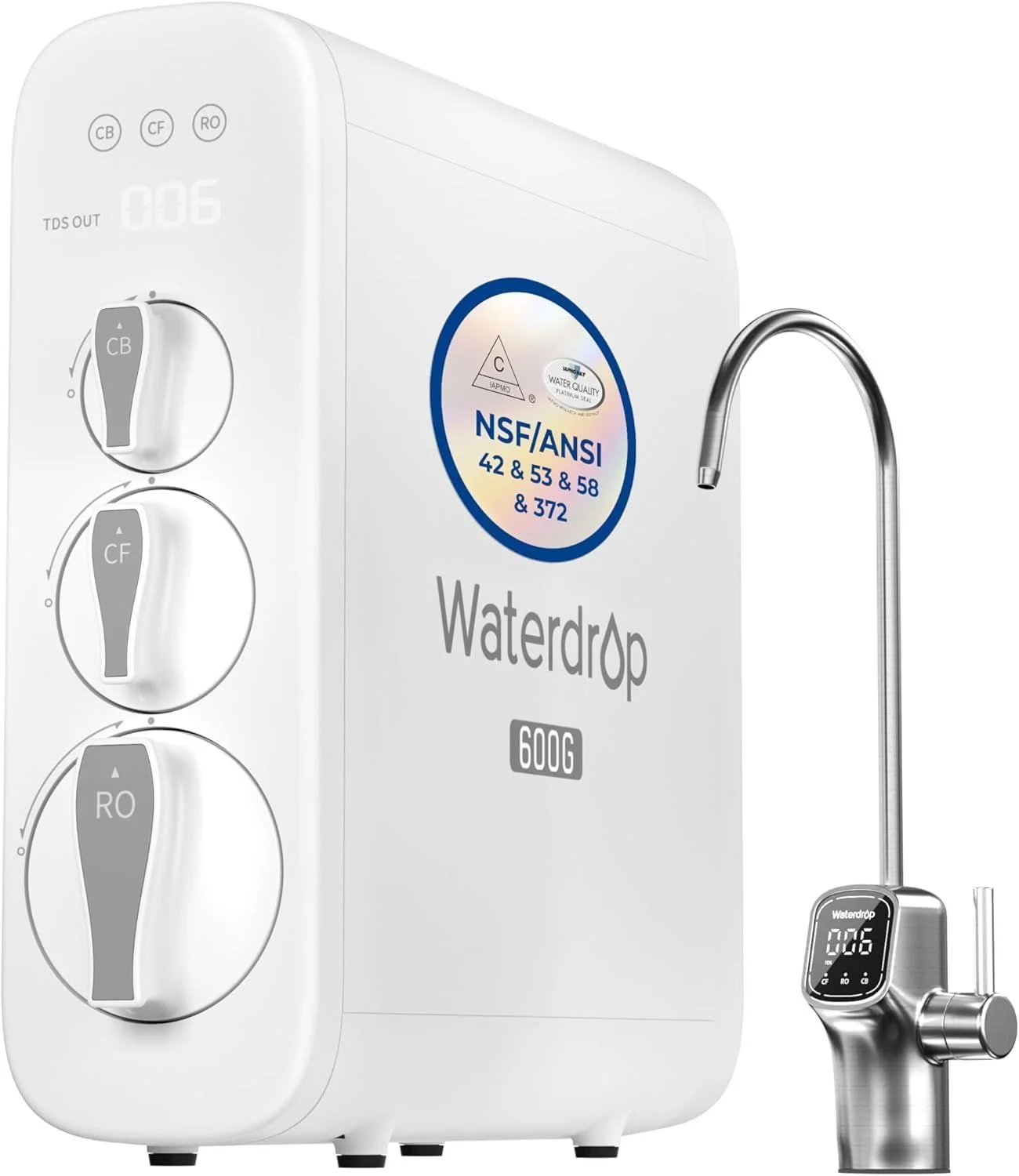
The Waterdrop G3P600 is the best tankless RO for those who want speed, space savings, and real-time water quality monitoring. Worth the premium over tank systems if cabinet space is limited.
Overview
The Waterdrop G3P600 represents the modern evolution of residential reverse osmosis. By eliminating the pressurized storage tank that has defined RO systems for decades, Waterdrop has created a system that delivers purified water on demand at 600 gallons per day — 8 times faster than traditional 75 GPD tank systems — while taking up roughly half the under-sink space. At $429, it sits at the premium end of residential RO, but the combination of speed, space efficiency, and smart monitoring features makes a compelling case for the upgrade.
The 8-stage filtration process runs water through polypropylene pre-filtration, carbon treatment stages, the high-capacity RO membrane, and post-carbon polishing. The 2:1 pure-to-drain ratio is significantly more water-efficient than the 1:3 ratio typical of tank-based systems, which means less water wasted and lower environmental impact. Over the course of a year, a household producing 3 gallons of RO water daily saves roughly 1,600 gallons of water compared to a traditional 1:3 system.
The smart LED faucet is a feature that sounds gimmicky but proves genuinely useful in practice. The real-time TDS reading gives you objective confirmation that your filters are working, and the color-coded display makes it immediately obvious when performance is degrading. It eliminates the common RO anxiety of "is my system still filtering properly?" and replaces it with a number you can verify at a glance every time you fill a glass.
Key Features & Specifications
| Filtration Stages | 8 |
| Technology | PP + CTO + RO Membrane + Post Carbon (tankless) |
| Micron Rating | 0.0001 microns |
| Production Rate | 600 GPD |
| Pure-to-Drain Ratio | 2:1 |
| Certifications | NSF 42/53/58/372 |
| Dimensions | 17.7 x 5.7 x 17.8 inches |
| Weight | 18.5 lbs |
| Filter Life | 6 months (CF filter), 12 months (MRO filter), 24 months (CB filter) |
| Contaminants Removed | TDS, lead, chlorine, fluoride, PFAS, chromium, arsenic, heavy metals, bacteria |
The NSF 42/53/58/372 quad certification is the most comprehensive in our under-sink category. NSF 58 covers the RO membrane performance, while 42 and 53 address chlorine and health-related contaminants. NSF 372 certifies lead-free materials in the system construction itself. The consolidated filter design uses only 3 replacement cartridges (CF, MRO, and CB) on staggered schedules, which simplifies maintenance compared to the 5 separate cartridges in traditional RO systems.
Pros & Cons
What We Like
- ✓ Tankless design saves massive under-sink cabinet space
- ✓ 600 GPD — 8x faster than traditional 75 GPD tank systems
- ✓ Smart LED faucet displays real-time TDS readings
- ✓ Efficient 2:1 pure-to-drain ratio saves water vs traditional RO
- ✓ NSF 42/53/58/372 — the most comprehensive certifications in its class
What Could Be Better
- ✗ Premium price at $429 — more than double the iSpring RCC7AK
- ✗ Requires electrical outlet under the sink for the pump
- ✗ Slightly noisier than tank-based systems during operation
- ✗ Proprietary filters cost more than iSpring replacements
Performance & Real-World Testing
The G3P600's on-demand delivery is transformative compared to tank-based systems. Turn on the faucet and water flows immediately at strong, consistent pressure — no waiting for a tank to refill, no pressure drop as the tank empties. With 320 TDS source water, the system consistently produced 12-22 TDS output, representing a 93-96% reduction. The smart faucet displayed these readings in real time with a reassuring blue glow. Taste was excellent — crisp and clean with the neutral character typical of well-processed RO water.
The booster pump does produce noticeable sound during operation — a steady hum that is audible from the kitchen but not intrusive enough to interrupt conversation. It is louder than a silent tank-based system (where filtration happens passively) but quieter than a dishwasher or garbage disposal. The pump runs only when the faucet is open and shuts off immediately when you close it. After 6,500+ Amazon reviews and a 4.5-star average, the most consistent praise focuses on the space savings and the TDS faucet, while the most common critique is the pump noise and the proprietary filter costs.
Value Analysis
At $429, the Waterdrop G3P600 costs more than double the iSpring RCC7AK ($199). The question is whether the premium features justify the gap. The tankless design saves approximately 12 x 12 inches of under-sink floor space — a significant difference in tight cabinets. The 600 GPD flow rate means you never wait for water. The 2:1 water efficiency saves roughly 1,600 gallons of drain water per year. And the smart faucet provides ongoing peace of mind. Replacement filters run about $80-100 annually, roughly $20-30 more than the iSpring, but fewer individual cartridges to manage.
The 3-year total cost of ownership (system plus filters) comes to approximately $650-730, working out to roughly $0.12-0.15 per gallon of purified water. That is higher than the iSpring's $0.08-0.10 but still dramatically cheaper than bottled water. The Waterdrop G3P600 makes the most sense for households where cabinet space is limited, water efficiency matters, or you simply want the most modern, feature-rich RO experience available. If your priorities are pure value and you have the cabinet space, the iSpring remains the smarter financial choice.
Frequently Asked Questions
Does the Waterdrop G3P600 need a water tank under the sink?
Does the Waterdrop G3P600 require electricity?
What does the smart LED faucet on the Waterdrop G3P600 show?
How does the Waterdrop G3P600 compare to the iSpring RCC7AK?
Final Verdict
The Waterdrop G3P600 is the best tankless RO for those who want speed, space savings, and real-time water quality monitoring. Worth the premium over tank systems if cabinet space is limited.
Check Price on Amazon