Understanding TDS: Total Dissolved Solids in Water
TDS — total dissolved solids — is one of the most commonly cited water quality metrics, but also one of the most misunderstood. A TDS reading tells you how much stuff is dissolved in your water, but not what that stuff is. Understanding TDS helps you evaluate water filter performance, but relying on it as the sole measure of water safety is a mistake we see too often.
What Are Total Dissolved Solids?
Total dissolved solids (TDS) is a measurement of all inorganic and organic substances dissolved in water. These include minerals, salts, metals, cations (positively charged ions), and anions (negatively charged ions) that pass through a 2-micron filter.
TDS is measured in parts per million (ppm) or milligrams per liter (mg/L) — these units are effectively interchangeable for water. A TDS reading of 300 ppm means there are approximately 300 milligrams of dissolved substances per liter of water.
Common Substances That Contribute to TDS:
- Beneficial minerals: Calcium, magnesium, potassium, sodium, bicarbonates — these are the minerals that give water its taste and provide trace nutrition.
- Harmless salts: Sodium chloride, calcium carbonate, and other naturally occurring salts from geological sources.
- Potentially harmful substances: Lead, arsenic, nitrates, fluoride (at high levels), hexavalent chromium — contaminants from industrial, agricultural, or plumbing sources.
- Organic compounds: Dissolved organic carbon from decomposing plant matter and agricultural runoff.
This is why TDS alone does not tell you whether water is safe. Water with 250 ppm of calcium and magnesium from a natural spring is perfectly healthy. Water with 250 ppm dominated by lead, arsenic, and industrial chemicals is dangerous. The number is the same, but the composition is completely different.
How to Measure TDS
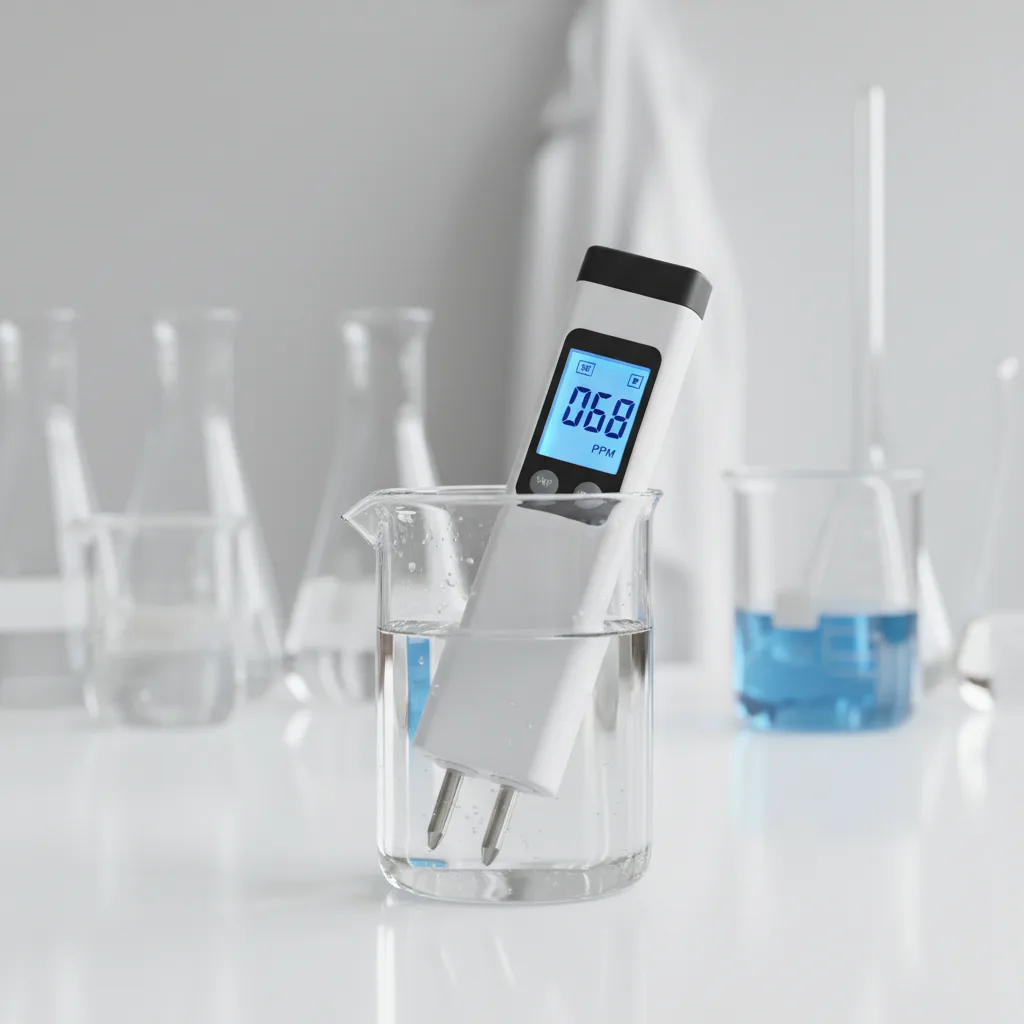
The most practical way to measure TDS at home is with a handheld TDS meter. These devices cost $10 to $20 and are widely available on Amazon. They work by measuring the electrical conductivity of water — dissolved ions conduct electricity, so higher conductivity indicates higher TDS.
How TDS Meters Work:
- The meter has two electrodes that contact the water sample.
- A small electrical current is passed between the electrodes.
- The meter measures how easily the current flows (conductivity).
- A conversion factor (typically 0.5 to 0.7) translates conductivity to an estimated TDS reading in ppm.
Important limitation: TDS meters measure ionic conductivity, not actual dissolved solids by weight. They cannot detect non-ionic substances (like certain organic chemicals and some PFAS compounds) because those substances do not conduct electricity. A TDS meter might read 0 ppm while organic contaminants are still present.
TDS Ranges and What They Mean
Here is a general framework for interpreting TDS readings, keeping in mind that the specific substances matter more than the total number:
0 to 50 ppm: Very Low TDS
Typical of RO-filtered water, distilled water, and rainwater. ZeroWater filters achieve near-0 TDS through ion exchange. Water at this range may taste flat because minerals that contribute to taste have been removed. Some RO systems add minerals back through a remineralization stage to reach 30 to 60 ppm.
50 to 170 ppm: Low to Moderate TDS
Common in areas with soft water or effective municipal treatment. Generally excellent drinking water. Many bottled water brands fall in this range. This is also the typical output of RO systems with remineralization.
170 to 300 ppm: Moderate TDS
The most common range for US municipal water. The World Health Organization classifies this as "excellent" to "good" quality. Most people find water in this range tastes fine. A basic carbon filter for chlorine taste improvement is usually sufficient at these levels.
300 to 500 ppm: Elevated TDS
Still within the EPA's secondary guideline of 500 ppm. Water may taste slightly mineral-heavy. Common in areas with hard water, limestone geology, or agricultural influence. At this level, an RO system provides noticeable improvement in taste and reduces dissolved contaminants.
500+ ppm: High TDS
Exceeds the EPA's recommended guideline. Water often has a noticeable mineral or salty taste. May cause scale buildup in pipes and appliances. An RO system or whole-house treatment is recommended. Well water in certain regions routinely exceeds 500 ppm.
1,000+ ppm: Very High TDS
The EPA classifies water above 1,000 ppm as unacceptable for drinking. Common in brackish groundwater and some well water sources. Requires reverse osmosis treatment before consumption.
TDS and Water Safety: Common Misconceptions
Misconception 1: Low TDS = Safe Water
A TDS meter cannot detect many dangerous contaminants. PFAS at harmful levels contribute negligibly to TDS readings. Bacteria and viruses are not measured by TDS. Even water reading 0 ppm could contain harmful organic compounds. TDS is useful but incomplete.
Misconception 2: High TDS = Dangerous Water
Water with 400 ppm of calcium and magnesium is perfectly safe — it is just hard water. Many natural mineral waters sold as premium products have TDS readings of 500 to 1,500+ ppm. The TDS level tells you something about the water but not everything.
Misconception 3: 0 TDS Is Ideal
Extremely low TDS water is not inherently better for health. The World Health Organization has noted that very low mineral content water may not be optimal for long-term consumption because you lose the trace mineral contribution from drinking water. Water at 30 to 150 ppm with natural mineral content is considered ideal by most health authorities.
Which Water Filters Reduce TDS?
Not all water filters affect TDS. Here is how different technologies compare:
Significant TDS Reduction (90%+):
- Reverse osmosis: 93% to 99% TDS reduction. The iSpring RCC7AK is independently tested at 93-98% TDS reduction.
- Distillation: 95%+ TDS reduction through evaporation and condensation.
- Ion exchange (deionization): ZeroWater uses 5-stage ion exchange to reach 0 TDS.
Minimal TDS Reduction (0-15%):
- Activated carbon (pitcher filters): Brita, PUR, and similar filters remove chlorine and some organic compounds but do not significantly reduce TDS.
- Carbon block (refrigerator filters): GE XWFE, everydrop, and similar filters target specific contaminants but leave most dissolved minerals intact.
- Sediment filters: Remove particles but have zero effect on dissolved solids.
- UV purification: Kills bacteria and viruses but does not affect TDS at all.
Using TDS to Monitor Filter Performance
Where TDS meters truly shine is monitoring RO system performance over time. Here is how to use TDS readings effectively:
- Baseline your tap water: Measure your unfiltered tap water TDS. This is your reference point. It may fluctuate seasonally by 10% to 20%.
- Measure RO output when new: Record the TDS of your RO-filtered water when the membrane is new. This is your "best case" number.
- Monitor monthly: Test your RO output TDS once a month. A gradual increase is normal over the membrane's 2 to 3 year life.
- Replace when output exceeds 10% of input: If your tap is 250 ppm and your RO output creeps above 25 ppm, the membrane is losing effectiveness and should be replaced.
- Check after filter changes: Always test TDS after replacing pre-filters or the membrane to confirm the system is working correctly.
TDS in Well Water vs. Municipal Water
Well water and municipal water have fundamentally different TDS profiles:
Municipal water typically ranges from 100 to 400 ppm. Treatment plants control TDS to some extent, and the EPA's secondary guideline of 500 ppm provides a soft cap. TDS is relatively consistent throughout the year.
Well water TDS varies enormously by geology and location — from under 100 ppm in some areas to over 2,000 ppm in others. TDS can change seasonally based on rainfall, drought, and aquifer conditions. Well water with high TDS often contains elevated levels of minerals like iron, manganese, calcium, and sometimes problematic contaminants like arsenic or nitrates. If you are on well water, a comprehensive lab test (not just TDS) is essential before choosing a filtration system.